
Wispr Flow is a voice dictation app that, by public accounts, went from nothing to a $2 billion valuation in about two years. A large part of that run was paid social, and the engine behind the paid social was not a clever campaign structure. It was a creator programme.
The story has mostly been told as a Silicon Valley one, because Wispr sells software. Read it as an ecommerce operator and it looks very familiar. Creators film the ads, they are paid on performance, and one media buyer turns the winners into spend. The best DTC brands have worked this way for years. What Wispr added is discipline.
This post pulls out the parts that transfer to a DTC brand, changes the part that does not (how creators get paid), and works through the commission maths at a 5x ROAS. A note on sources: every Wispr figure below is as publicly reported, and we have not verified any of it. Treat the numbers as an illustration of the model, not a benchmark.
The model is simple. The brand recruits creators to film its ads and pays them a share of what those ads earn. Everything runs as paid, not organic.
The reported scale is large. Between 500 and 700 new UGC ads a month, with a target of 1,000. Around 50 creators accepted out of more than 5,000 applicants. Roughly $220k paid out to creators so far, with the top creator earning about $12k a month. The programme went from 5 creators to 10, 20 and then 40, levelled off at 40 to 60, and the whole climb took about four months. One media buyer runs all of it.
The Meta Ad Library gives a sense of the volume. Filtered to active ads in the US, Wispr Flow shows around 1,300 results at the time of writing (October 2026). The count may include variants of the same ad, but the scale is clear. Most DTC brands do not need anything like this number, and we are not suggesting you aim for it.

About a year ago Wispr stopped producing organic UGC and put the effort into paid. The reasoning is worth repeating. Organic only works with real on-screen talent, because the algorithm rewards creators people want to watch. Paid works for anyone who can ship enough different ads.
You do not need a genius. You need a steady supply of ads that each look and sound different, and a system that keeps them coming. Most small DTC teams cannot hire a creator who has built an audience. They can brief five good creators who film clean, believable product videos. For more on how this plays out in practice, see our guide to scaling ecommerce ads.
The second idea is the more important one. Meta's delivery system is reported to group ads that are too similar and treat them as one. The figure quoted for Wispr's programme is videos that are 50 to 60% alike. Meta has not published a threshold, so take that as a rule of thumb. The practical point holds either way: ten talking heads saying the same thing in the same kitchen behave like one ad.
So the number that matters is not how many videos you have. It is how many genuinely different ads. A different person, setting, hook and customer. Reach also tends to get more expensive over time, which leaves creative quality and variety as the main thing you control.
Wispr gives each creator a single customer segment. The brief is a gap: a customer no ad is speaking to, a format nobody has shot, a market with nothing running. One creator per gap.
For a DTC brand, a gap usually falls into one of three types:
List what is missing from your live ads and write one brief per gap. A creator who knows exactly which hole they are filling makes more varied content than one told to make something for the brand.
Wispr pays 7% of ad spend, uncapped, every 7 days. That suits software, where a sale can take weeks to close and revenue is a poor basis for weekly pay. DTC is different. Orders arrive within minutes or days, so paying on sales is both possible and fairer.
We would open the conversation at 3% to 5% of net sales from the creator's ads, paid weekly or fortnightly. Net sales here means after discounts and refunds, before VAT.
New creators also need a reason to try you before they have earned anything. Wispr offers a guaranteed minimum, reported at $1,000 for 20 to 25 videos a month. It works as a floor, not an extra. If a creator earns $500 in commission, the brand tops it up by $500. Once commission passes $1,000, the guarantee stops. That is how Wispr signed good creators before it had a track record.
A small DTC version might be a £400 monthly guarantee for around eight videos, with commission counting towards it. Treat those numbers as a starting point to adjust to your margin and category.
Take one creator whose ads receive £1,000 of Meta spend in a month at a 5x ROAS, measured on net sales.
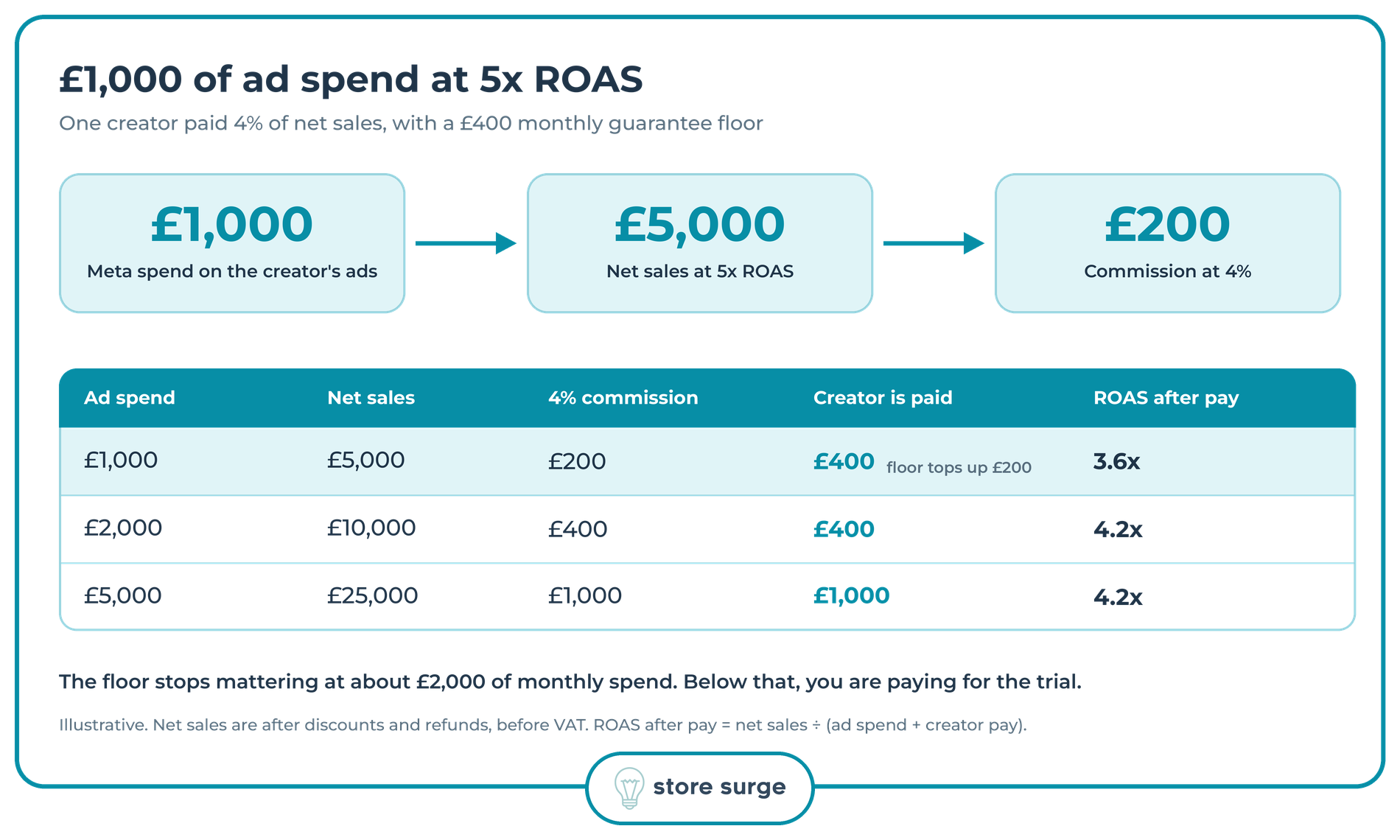
That last line is worth pausing on. Wispr pays 7% of ad spend. At 5x ROAS, a 4% commission on sales works out at 20% of ad spend, nearly three times as much. A physical product at a healthy margin can often absorb it, but it is not free, so check it against your own numbers first.
Now add margin. Assume a 60% gross margin, which is an illustration, so swap in yours.
Then add the £400 guarantee floor.
The guarantee stops mattering once a creator's ads reach about £2,000 of monthly spend. Below that, you are paying for the trial.
The maths only works if your margin and ROAS support it. At 2x ROAS and a 60% margin, £1,000 of spend leaves £200 of gross profit before any commission, and a 4% rate takes £80 of it. Run your own figures before you offer a rate.
Agree how a sale is credited before anyone films anything. We would use ad-level results in Meta Ads Manager, with each creator's ads named so they can be isolated, plus a unique code or link per creator as a cross-check. Meta's attribution is imperfect and can over- or under-credit depending on the window, so put the window in writing. Disputes over attribution are the easiest way for these arrangements to sour.
Wispr scaled to around 50. You should not start there. Wispr had a media buyer, a budget and a product with plenty of proof. Start with one to five creators, each on a different gap, and let results decide whether you add more.
Wispr kept its group small on purpose, on the logic that $100k split between 20 creators looks better to those creators than $200k split between 1,000. The same applies at your scale. Keep the group small enough that each creator can see what they are earning. Add a creator only when the existing ones have real spend behind their ads and you have found another gap to fill. One person can run it. One media buyer manages all of Wispr's.
Wispr recruits on Instagram using keyword search. The method transfers directly.
If you would rather not hunt creator by creator, a marketplace is a faster way to build a first shortlist. Clip is one example. It says it has over 10,000 vetted creators across the US, UK and Australia, lets you browse by niche, and shows each creator's location and rating. It also displays a 4.64 average from 309 reviews on REVIEWS.io, which is worth reading for yourself before you pay anyone.

One difference from the model above: marketplaces like Clip charge per video, with creators setting their own rates, rather than paying commission. We would use one as a way to find and test creators, then move the ones who perform onto a net-sales commission agreed directly. Prices change, so check the current rates on the site. Before you run anything as a paid ad, confirm in the terms that the usage rights cover paid advertising, not only organic posting.
Wispr treats creators like a sales team. Each gets a 30-minute onboarding, a weekly call with the media buyer and one-to-one time with creator coaches. Every week the media buyer walks them through the ad account: what is working, which customer to target next and what to test.
Creators who understand the numbers make better ads. At small scale you do not need coaches. A 30-minute weekly call and a screen share of the winners will do it. We would share results that way rather than hand over account access.
When a creator sees a winning ad, the natural move is to make their own version. Wispr discourages this and asks for something new instead. A copy of a winner is likely to be treated as the same ad, so it rarely gets delivery, and you have paid for a video that adds nothing.
The fix is in the brief. Show creators which angle is working, then ask them to film something that does not resemble it: a different setting, a different opening line, a different person speaking to a different problem. Check new uploads against what is already live before they go into the account.
The Meta Ad Library is a fast way to see how varied a brand's live ads actually are. Wispr's ads lead with different use cases, and several carry a partnership label that suggests creator-led content. We cannot see the deal terms, so that part is an inference. For another look at a brand's Meta creative, see our DASH Water teardown, our Ridge Wallet Meta ads teardown or our Meta ad examples.

Wispr's explanation is that brands accept everyone who applies, nobody coaches the creators, and creators join without realising they are only paid when their ads perform. All three can be fixed in the first month: choose carefully, coach weekly and state the pay model in the first message. For a DTC example of influencer-led scaling, see how HiSmile uses influencers to scale.
Expect early results to be thin. A week of data on a handful of ads tells you little, so judge the programme on months two and three.
If you want help running a creator-led ads programme on Meta alongside the rest of your paid media, see our Meta ads service or get in touch.
