
Ridge began as a father-and-son Kickstarter campaign and has never taken a dollar of outside capital since. In a Sacra interview, CEO Sean Frank is asked about $200 million in revenue and does not dispute the figure, going on to describe it as the path to a billion-dollar business. He has separately said the wallet alone holds about 1% of the global wallet market. In 2024 the company grew more slowly than at any point since 2020 and still added eight figures of revenue, with eight figures of profit behind it.
The number that explains how is on the Open Residency episode with Frank, where he describes Ridge confidently spending $100,000 a day on ads. That is roughly $36m a year, from a business with no investors to absorb a bad quarter.
Nobody spends at that rate on the strength of one winning campaign. At the time of writing Ridge is running more than 250 distinct creatives across Facebook and Instagram in the US alone. This is a teardown of what that machine actually looks like, and of the two channels feeding it that most brands never consider.
In this article
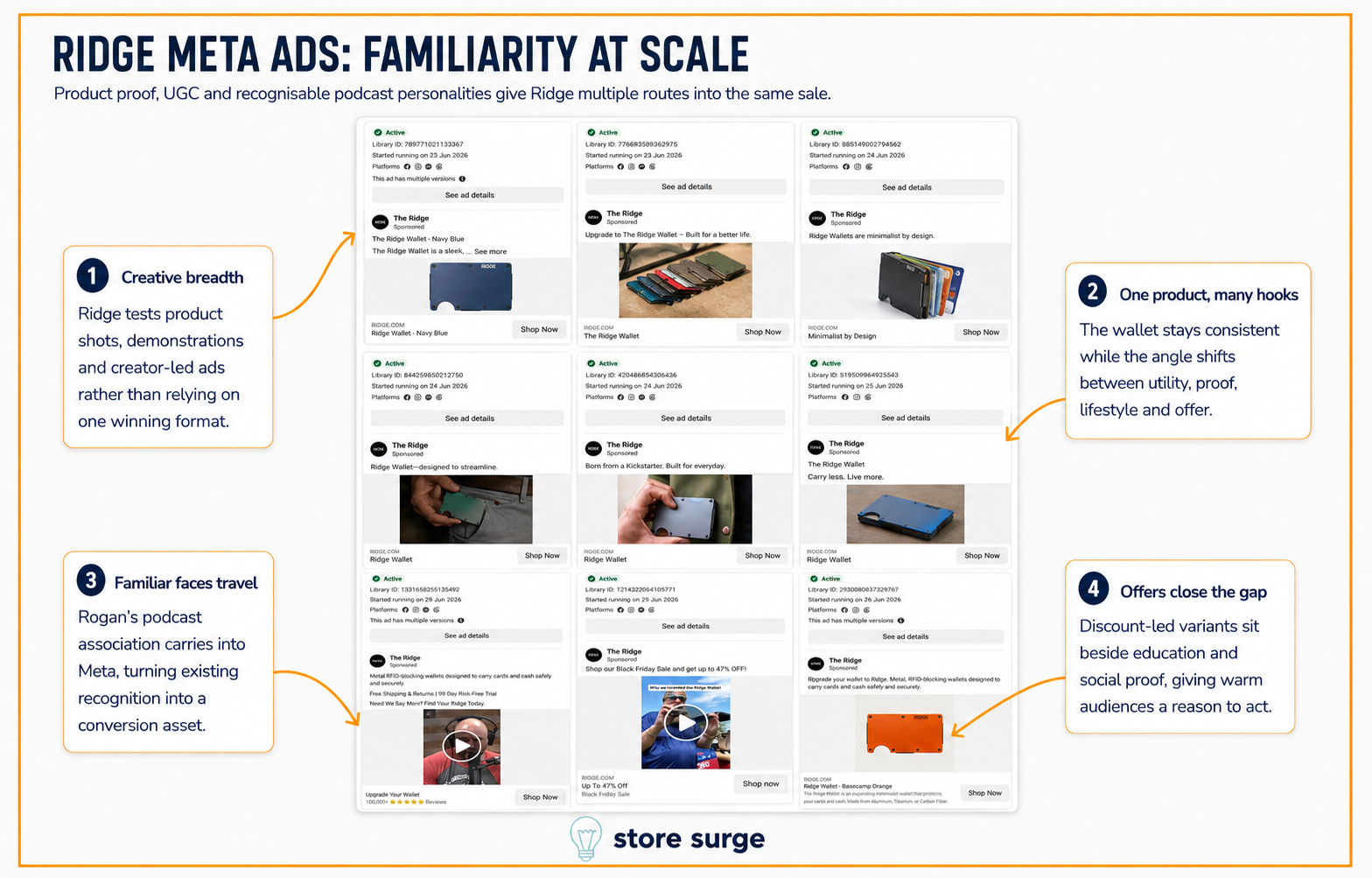
Nine ads, all live, all started within a week of each other in late June 2026. One product in every single one.
What changes is the angle. Some sell the object: a navy wallet, a flat lay of the full colour range, cards fanned out of an aluminium frame. Some sell the philosophy, with Carry less, live more, and Ridge wallets are minimalist by design. One sells the origin story directly, with Born from a Kickstarter, built for everyday. One sells the specification, naming metal construction, RFID blocking, free shipping and returns and a 99-day risk-free trial in a single block. One sells the discount, at up to 47% off.
Frank's argument on that podcast is that simplicity beats cleverness in performance creative, and the library backs him up. Not one of these ads is trying to be funny or oblique. They state what the thing is, from a slightly different position each time.
That is what 250 creatives are for. Not 250 ideas, but a handful of angles rendered enough ways that Meta's delivery system has something to optimise against for every audience segment. A brand running four ads is asking the algorithm to choose between four options. Ridge is giving it a real search space.
Two of the nine are creator videos rather than brand assets, and one of those is a recognisable podcast host. That is not a coincidence, and it leads to the more interesting half of this story. Getting the structure of an account like this right is most of what Meta ads management consists of once the basics are in place.
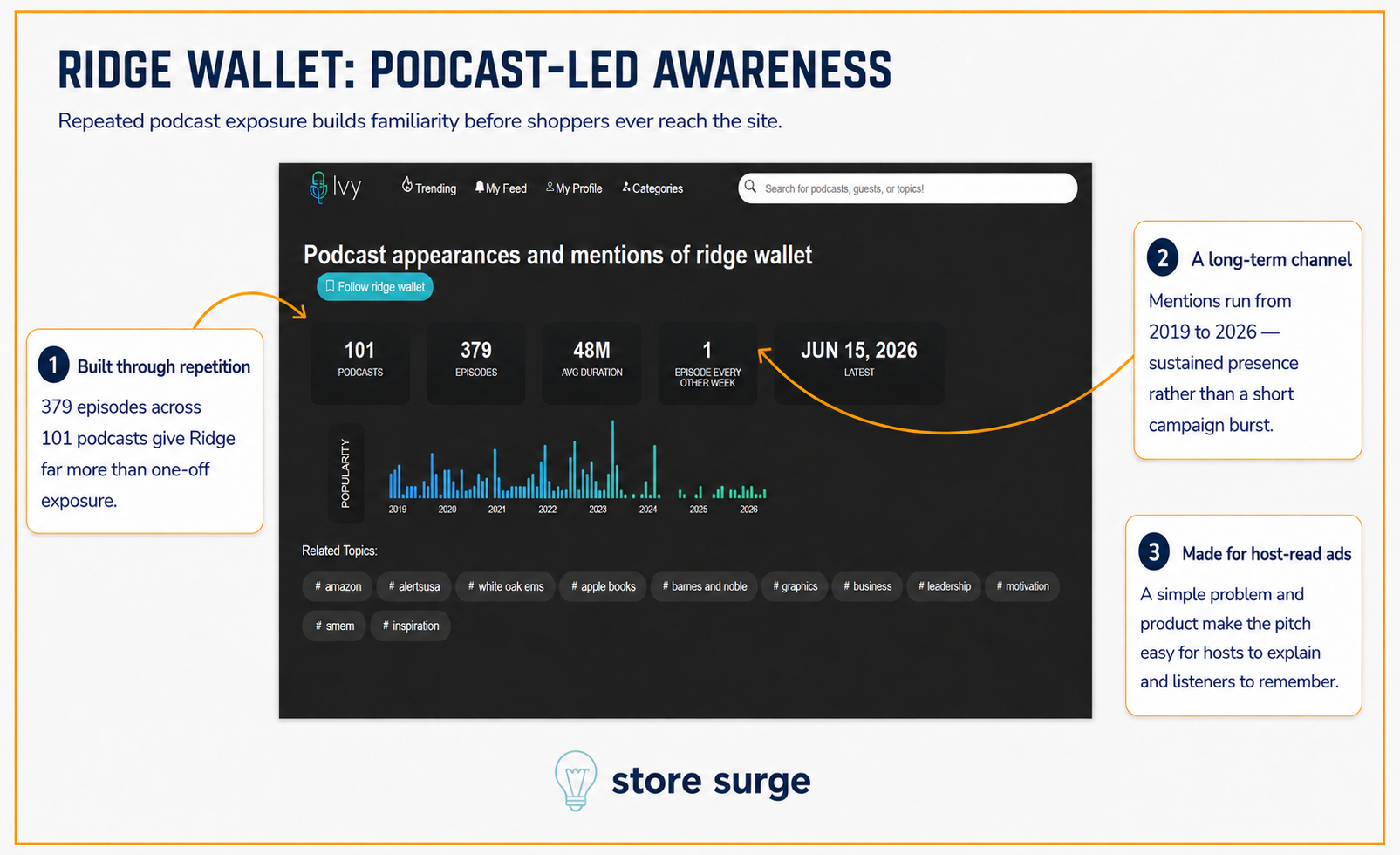
Pull Ridge's podcast footprint and the picture changes completely. Ivy.fm lists 379 episodes across 101 podcasts mentioning the brand, with an average episode length around 48 minutes and roughly one new appearance every other week. The chart runs from 2019 to 2026 without a meaningful gap.
Seven years of continuous host-read advertising. Not a campaign, a channel.
This is the thing that makes the Meta account work, and it is invisible if you only look at the Ad Library. A cold audience seeing a metal wallet in their feed has to decide whether an unfamiliar brand is trustworthy. An audience that has heard a host they like describe the same wallet, in their own words, across dozens of episodes over several years, is not cold. The Meta ad is not creating the belief. It is collecting on it.
The product helps enormously here. A wallet that is thinner, holds cards and blocks RFID is a pitch a host can deliver from memory in forty seconds. Brands with complicated products struggle on podcasts for exactly this reason.
You can see the same pattern in Ridge's wider sponsorship footprint, which extends well past podcasting.
The YouTube side runs on the same logic, and the scale of it is easy to underestimate. Back in 2020 alone, Frank has said Ridge worked with roughly 750 influencers, spending $3.9m across 3,000 unique videos. That is around ten new sponsored videos going live every day, in a single year, six years ago.
He has since put total influencer spend above $10m, and argues the returns are better in non-endemic placements than obvious ones. His example is Linus Tech Tips: a technology review channel, not a fashion or accessories one, reaching an audience of men who buy things.
The reasoning is worth stealing. A tech reviewer recommending a wallet is not staking their credibility on a category they are known for, so the endorsement costs them less and reads as more genuine. The ad space is less contested, because the other wallet brands are all bidding on wallet content. And the audience overlap is high without the audience being saturated.
So the sequence for a large share of Ridge's customers is: hear it on a podcast, see it on a YouTube channel about something else entirely, then meet a Meta ad that closes. Three touchpoints, only one of which shows up in the ad account's attribution.
Ridge has since taken this further than sponsorship. Marques Brownlee, better known as MKBHD, joined the company's board. Frank's description of why is the most self-aware thing in any of these interviews: the aim is to become more of a content-first brand and get better at storytelling, rather than just running static image ads on Facebook.
That is worth sitting with, given everything above. The brand held up as a Meta advertising benchmark has publicly said the static image ad is the part it wants to grow out of.

The popup does not lead with a percentage. It says Unlock your wallet offer, pick a box to reveal your deal, and shows three boxes marked with question marks.
The discount is hidden behind an interaction. That is the entire mechanic, and it changes the decision the visitor is making. A popup offering 10% off invites an immediate judgement about whether 10% is worth an email address. A popup offering an unknown reward invites a click, and the click is a smaller commitment than the judgement.
Product imagery fills both edges of the frame, wallets and a key case, so the reward stays visually tied to the thing being sold rather than floating free as a generic voucher.
We captured the entry state only, so what sits behind the boxes is not visible here. The structure is familiar enough, though, and the principle transfers directly to any email marketing capture: a small action is easier to take than a small decision.

The wallet is $95, and the page is built to make that number the beginning of the order rather than the end of it.
Two finishes, then a colour grid of roughly thirty options including patterns and flags. That grid is doing more than offering choice. It makes personalisation feel like the point of the product, and a shopper who has picked a specific colourway has started to own the thing before adding it to a basket.
Directly underneath sit four Modern Attachments, a cash strap, an AirTag cash strap, a money clip and a key case, then an Enhance It block with a Truckplate at $10 and a laminated RFID plate at $20, then a gift wrap tick box. Every one of those is inside the buying panel rather than further down the page or waiting in the cart. The order is built where the decision is made.
Reassurance is stacked tight around it: lifetime warranty, free returns, 99-day trial, fast and free shipping over $99, 12,000-plus five-star reviews. Above the fold, a row of icons repeats add-on accessories, 99-day returns, ships next day, stainless steel hardware and RFID blocking.
For a $95 product that is a lot of reassurance. It is there because the objection is not price, it is whether a metal wallet is a sensible thing to own.

Further down, the page stops selling a wallet and starts selling engineering.
Four claims open the section: 10x lighter, improved modularity, design enhancements, built-for-life warranty. Each gets one line. Re-engineered to weigh up to 10 times less than other wallets. A new modular system for accessory customisation.
Then the exploded view, which is the best asset on the page. The wallet is shown in pieces, plates and screws and elastic separated out and numbered, with a Built For Life panel beside it naming the RFID blocking plate, the card index, the money clip options and the warranty.
This is how you justify $95 for a wallet. A finished metal rectangle looks simple. The same object shown as eight components that had to be designed to fit together looks like a piece of hardware. The picture is making the value argument that the price tag cannot.
The section closes on durability rather than lightness, with the Built For Life warranty given its own full-width banner. That order matters. Lightness is why you want it. A lifetime warranty is why $95 is not expensive.

The recommendation row comes before the reviews, and every item on it belongs to the same system: a tool kit at $25, a cash strap at $19, a leather case at $26. Nothing over about a quarter of the wallet price, and nothing that competes with the wallet itself.
Then 4.8 from 5,467 reviews, with the full distribution shown. Worth noting that the distribution is not flattering by construction. There are 200 one-star reviews against 45 two-star and 127 three-star, so the shape is a J rather than a smooth curve. Ridge shows it anyway, which is the correct decision, because a hidden distribution is more suspicious than an imperfect one.
Customer photos sit above the written reviews, and every reviewer carries a Verified Buyer badge. A separate Questions tab holds 710 entries. The reviews themselves are long and specific, mentioning years of ownership and multiple wallets bought.
The footer then makes one more ask, offering 10% off a first order in exchange for an SMS signup. Different channel, different reward, second attempt at the same visitor.
Four things, and one of them looks like a straightforward mistake.
A Black Friday ad is running in June. One of the nine live creatives promotes a Black Friday sale at up to 47% off, with a start date in late June 2026. Either an old asset has been reactivated without the copy being updated, or the offer name is being used as an evergreen discount label. Neither is good. A brand that discounts by 47% under a seasonal banner in midsummer is training its audience to wait.
Three different review counts appear on one page. The header shows 19,131. The trust line says 12,000-plus five-star reviews. The review block itself says 5,467. There are plausible explanations, since one figure may cover all products and another only five-star ratings, but a shopper who notices will not go looking for the explanation.
The popup hides the value entirely. The mechanic lifts interaction, but a visitor who plays and receives a smaller discount than they hoped for has been given a small disappointment at the start of the relationship. Worth testing the revealed value against a stated one.
Add-ons are dense in the buying panel. Attachments, enhancements and gift wrap all sit above the fold beside the price. That is good for average order value and busy for a first-time visitor who came to buy one wallet. The question is whether it costs conversion rate more than it earns in basket size, and only a test answers it.
The temptation with a brand like Ridge is to study the ad account and try to copy the creative. The more useful lesson is that the ad account is the last step in a sequence, and the two steps before it happen on podcasts and YouTube channels where nobody is competing for the same attention.
Spending $100,000 a day is only rational if the audience already knows who you are. Ridge spent seven years making sure of that first, and by its CEO's own admission is now trying to move further away from the static feed ad, not closer to it.
If you are running Meta ads and suspect the ceiling is awareness rather than creative, our growth calculator will give you a rough sense of what the gap is worth before you commit to anything.
We run teardowns like this one on client accounts every week. If you want a look at yours, get in touch and we will walk through it with you.
