
Most Google Ads agencies optimise for the metrics Google gives them for free — platform-attributed ROAS, view-through conversions, and bidding strategies that look good in dashboards but don't account for actual margin.
Store Surge runs Google Ads exclusively for ecommerce brands doing £20K or more per month, with bidding strategies built around your real unit economics, not platform defaults.
Our team has run paid media inside ecommerce businesses doing £1M to £10M a year.
We've seen what happens when Google Ads is run on autopilot with target ROAS bids that don't reflect contribution margin, and we've rebuilt the accounts that suffered for it.
That operational background is what makes our approach different from agencies running their accounts on Google's recommended settings.
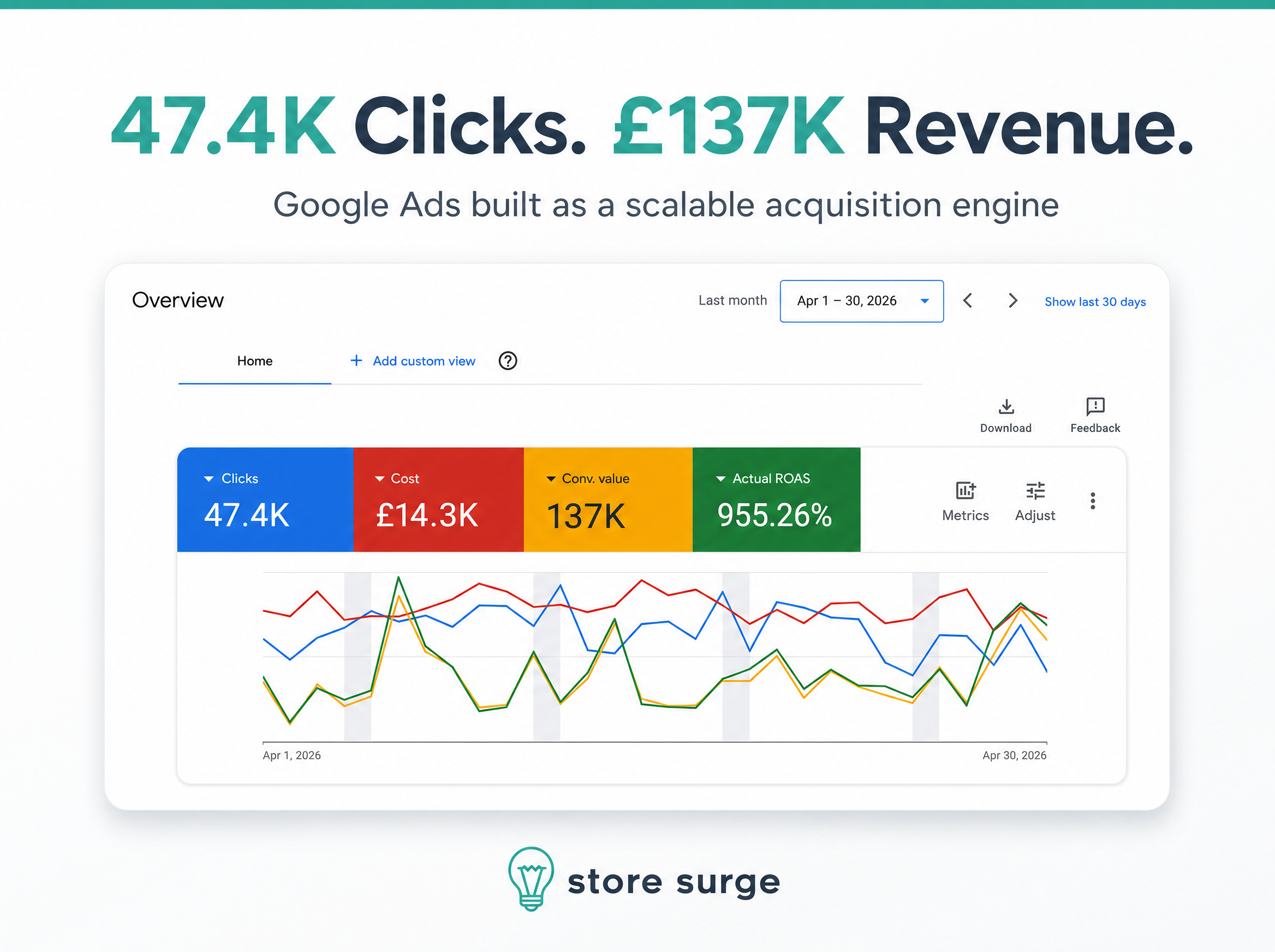
A Google Ads agency manages your advertising across Google's network — Search, Shopping, Performance Max, YouTube, and Display — including campaign structure, audience targeting, bid strategy, feed optimisation, and performance reporting. The goal is to grow paid revenue efficiently while you focus on the rest of the business.

Store Surge's Google Ads management starts at £999 a month. Pricing is set by account complexity, feed size and creative volume, not by how many platforms you buy — we run paid media as one system rather than as separate line items. For context, £999 a month is roughly a fifth of what a mid-level in-house media buyer costs once you add NI, pension and the months before they're productive. Book a call for a tailored quote.
Both work, but they work differently. Google captures existing demand — people searching for what you sell. Meta creates demand through discovery, particularly for brands in considered-purchase verticals. Most ecommerce brands we work with run both, with the split depending on margin, average order value, and brand awareness stage. We can audit your current mix and recommend the right allocation.
Performance Max is Google's AI-driven campaign type that runs across Search, Shopping, Display, YouTube, Gmail, and Discover from a single campaign. For most ecommerce accounts, yes — it's now the default for Shopping-led strategies. The question isn't whether to run it, but how to structure signals, asset groups, and exclusions so it performs properly. We manage that for every ecommerce client running PMax.
Results vary by vertical, margin, feed quality, and starting account health. Most clients see meaningful ROAS improvement within 4 to 8 weeks, with feed fixes often producing a measurable revenue lift in the first month. We give realistic, account-specific projections during onboarding rather than generic promises.
Yes, exclusively. That focus means the team isn't relearning ecommerce fundamentals on every account; every playbook, benchmark, and creative angle has already been tested on similar stores.
Google Ads is a different beast for ecommerce than it is for lead-gen. The platform is built around a product graph now — Performance Max, Shopping, broad match — and most of the optimisation playbooks that worked in 2019 are actively harmful in 2025. Ecommerce accounts that win on Google today are usually doing three things differently:
They treat the product feed as a first-class asset, not a setup task. Feed quality is the single biggest lever in Shopping and PMax performance, and most accounts we've audited have feed issues that are silently capping revenue.
They separate brand defence from non-brand growth. Bidding brand terms against your own brand at full CPCs is the most expensive mistake we see. A specialist account structure handles this from day one.
They bid on margin, not on revenue. Google lets you bid to a target ROAS. The question is what ROAS — the one Google calculates from a 7-day click window, or the one that actually pays your bills? The answer matters more than any single campaign setting.
If you're running Google alongside Meta, the two channels need to talk to each other — particularly around attribution and audience overlap.
See how we run Meta ads for ecommerceOr jump to our PPC management services →Most of the accounts we audit have the same handful of issues. If any of these sound familiar, the fix is usually faster than you'd expect:
- Performance Max campaigns with no signal feeding the algorithm
- Product feed missing GTINs, mismatched categories, or poor titles
- Brand campaigns bidding on competitor terms (or vice versa)
- Target ROAS bidding set without a margin-based target in mind
- No negative keyword strategy on Search and Shopping alike
- Search campaigns cannibalising brand traffic that would have converted organically
End-to-end Shopping and PMax — feed setup and ongoing optimisation, campaign structure, asset groups, and signal-based audience layering. PMax is the default campaign type for ecommerce now; we treat it as a sophisticated channel to manage, not a set-and-forget automation.
Hand-built Search campaigns for high-intent commercial queries, with the negative keyword discipline that keeps irrelevant clicks from eating your budget. For most ecommerce accounts, Search is now a smaller share of spend than it was five years ago, but it still drives the highest-margin conversions.
Used selectively for brand awareness and remarketing, not as primary revenue drivers. We use YouTube and Display where they make sense for the brand's stage and margin profile, and we're honest when they don't.
Product feed audits, GTIN fixes, category and title optimisation, and the data quality work that makes or breaks Shopping performance. Most of our clients see a measurable revenue lift in the first month from feed fixes alone.
Bid strategies built around what's actually driving profit, not Google's recommended target ROAS. This is where ex-ecommerce operators earn their fee — we know how to bid for margin, not just clicks.
Want the full-funnel view that includes performance marketing across Google, Meta, and retention?
See our performance marketing approach →We review your existing account, your product feed, your margin structure, and your current attribution setup. The audit usually surfaces 3 to 5 quick wins we can implement in the first two weeks — feed fixes, search term exclusions, or bidding strategy changes that improve performance without a full rebuild.
Campaigns go live within 10 to 14 days of onboarding, with the right structure from day one. You'll have a clear view of what we're testing, what we'd expect to win, and what we'll cut if it doesn't.
Weekly optimisation cycles, monthly feed reviews, and a quarterly strategy session. As the account matures, we layer in more sophisticated testing — new campaign types, audience experiments, and incrementality tests where the data supports them.
Scaled a padel brand across Meta and Google, expanding into international markets while driving profitable customer acquisition and revenue growth.
View case studyDrove scalable revenue growth for a national sofa retailer using Google, Meta and SEO, improving conversion efficiency and lowering blended CPA across channels.
View case studyScaled an elite cycling ecommerce brand from $10k to $200k/month using Meta, Google, TikTok, Klaviyo, SEO and site strategy for profitable growth.
View case studyIf you'd like a relevant case study in detail before booking a call, get in touch and we'll send one over.
Get in touch- Ecommerce-only focus — every account we run is Shopify or WooCommerce, doing £20K+ per month. No generalist client mix diluting attention or pulling us into a quarterly brand-awareness campaign for a fintech.
- Margin-first bidding — We bid toward what's actually driving profit, not Google's recommended target ROAS. The difference shows up in your P&L, not just your Google dashboard.
- Cross-channel thinking — Google doesn't run in isolation. We coordinate with your Meta, Klaviyo, and SEO efforts so attribution is honest and budgets aren't competing against themselves.
- Transparent pricing — plans start at £999 per month, covering paid media run as one connected system rather than priced platform by platform. No obscured "book a call to find out" pricing games. If we're not the right fit on price, we'd rather you find that out on the website than on a 30-minute sales call.
Written by Sam Park, Founder at Store Surge.
Sam Park has managed Google Ads for ecommerce brands across fashion, beauty, and home goods, with combined ad spend in the eight figures.
Most engagements start with a focused discovery and audit — typically 2–4 weeks — before moving into a longer retained or project-based relationship. We don't do retainers for the sake of retainers.