
Most brands run Amazon and their own store as two separate businesses. The customer does not see it that way.
Amazon has its own rules. Ad spend affects organic rank, listing quality caps what advertising can achieve, and ACoS on its own tells you very little about whether the account is making money. We manage Amazon PPC for ecommerce brands doing £20K or more per month, measured on total advertising cost of sale against real margin.
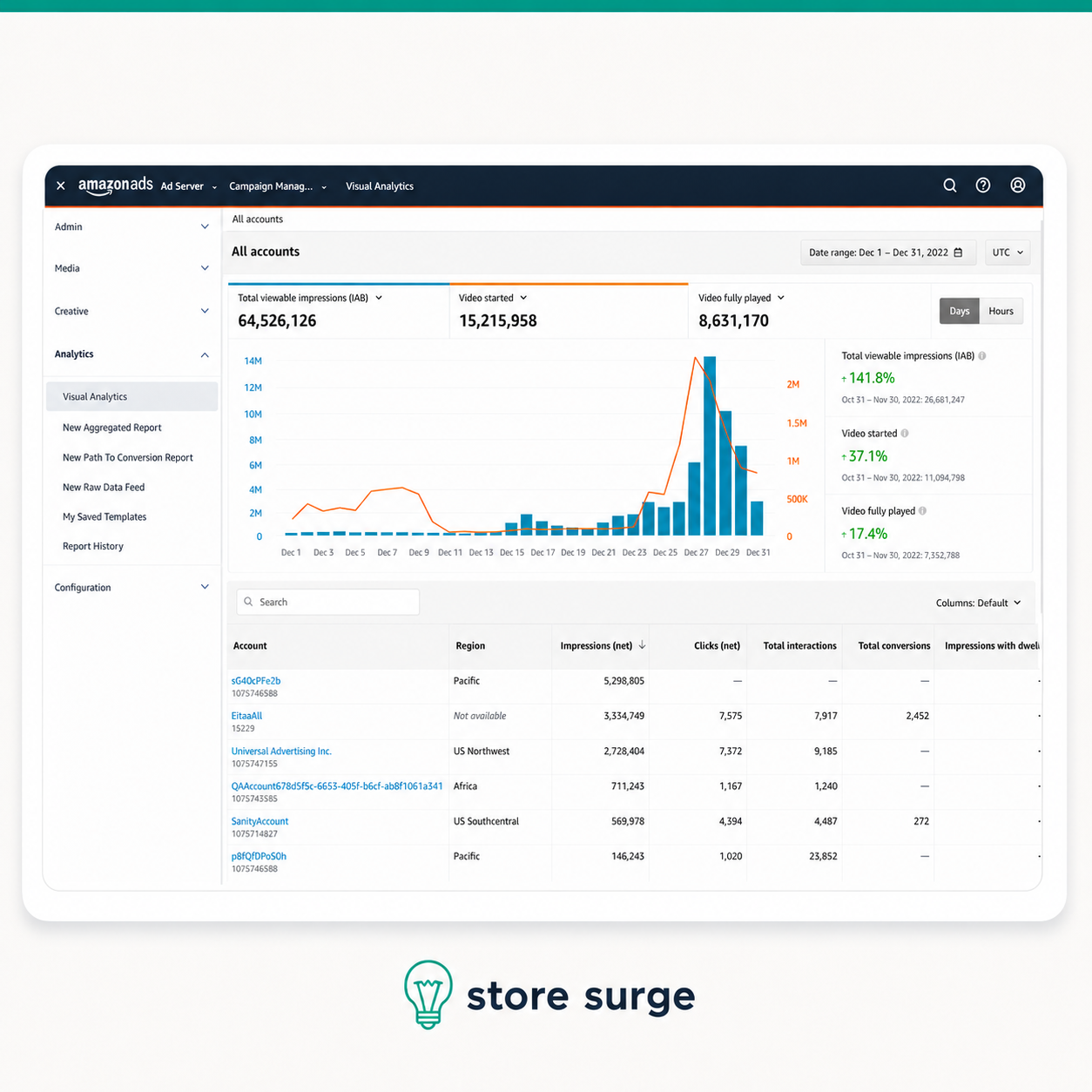
An Amazon PPC agency plans and runs Sponsored Products, Sponsored Brands and Sponsored Display campaigns inside Seller Central or Vendor Central. That covers campaign structure, bidding, keyword and search term management, and reporting. Listing quality is usually part of the work too, because it caps what advertising can achieve.

Store Surge plans start at £999 per month per platform, as a flat fee rather than a percentage of ad spend. Exact pricing depends on catalogue size and how many marketplaces you sell in.
ACoS measures ad spend against sales generated by those ads. TACoS measures ad spend against total sales, including organic. TACoS matters more on Amazon because advertising feeds organic ranking, so a campaign with unremarkable ACoS may be driving organic sales that never appear in the ad report.
Wasted spend can usually be cut within the first two weeks through negative keywords and bid adjustments. Restructuring and search term harvesting take 4 to 8 weeks to settle. Organic rank improvements from sustained advertising are slower again, typically showing over 2 to 3 months.
Yes, because the two cannot be separated. If a listing converts at half the category average, advertising simply loses money faster. We work on titles, images, bullets, backend keywords and A+ content as part of managing the account.
Yes, exclusively. Every engagement is for a brand selling through Shopify or WooCommerce alongside Amazon, doing £20K or more a month. We do not work with resellers or arbitrage sellers, because the economics and the strategy are different.
It depends on margin and what you want long term. Amazon brings volume and discovery but takes a significant cut and keeps the customer relationship. Your own store keeps the margin and the data but has to earn the traffic. Most brands need both, and the useful question is which products belong where.
Amazon rewards advertising differently from every other channel. Sales driven by ads feed back into organic ranking, so spend that looks break-even in isolation can be doing real work further down.
That cuts both ways. Advertising cannot fix a listing that converts badly, and pouring budget into a weak product page mostly funds Amazon. The account and the catalogue have to be worked on together. Three things we do differently:
We measure on TACoS, not ACoS. Total advertising cost of sale accounts for the organic lift that paid activity generates. ACoS in isolation makes profitable campaigns look wasteful and hides the ones quietly losing money.
We fix the listing before we scale the budget. Title, images, bullets, A+ content and review position all cap what advertising can do. Spending harder against a listing that converts poorly is the most common way to waste money on Amazon.
We plan Amazon and your own store together. Where you push customers matters, because margin, customer data and repeat purchase behaviour differ sharply between the two. That decision should be deliberate rather than accidental.
If you are also driving traffic to your own store, the same margin logic applies there. See how we run conversion rate optimisation for ecommerce and email marketing for ecommerce to understand the full-funnel picture.
See how we run conversion rate optimisation for ecommerceSee how we run email marketing for ecommerceCampaign structure across automatic, manual and exact match, with bids set by product margin rather than a single account-wide target.
Brand defence against competitors bidding on your terms, plus Sponsored Brands and Display for products where recognition genuinely shifts conversion.
Titles, images, bullets, backend keywords and A+ content. Advertising performance is capped by listing quality, so this is part of the work rather than a separate project.
Harvesting converting search terms out of automatic campaigns into exact match, and negating the ones spending without returning.
See our Google Ads approach →Reporting against total advertising cost of sale and contribution margin after Amazon fees, FBA costs and returns, rather than platform-reported ACoS.
Deciding which products belong on which channel, and making sure Amazon spend is not simply buying customers you would have won more profitably on your own site.
Want the full picture across Amazon, your own store and the rest of your paid media?
See our full services overview →We go through the ad account and the catalogue together: campaign structure, search term reports, wasted spend, and how each listing converts against its category. The output is a clear view of what advertising can realistically achieve before anything gets scaled.
We rebuild campaigns around the search terms that actually convert, set bids by product margin rather than one blanket target, and put negative keyword lists in place. Listing fixes run alongside, because they change what the ads are capable of.
Weekly search term harvesting, monthly reporting against TACoS and contribution margin after Amazon fees, and quarterly reviews of which products deserve budget. Spend follows profit rather than revenue.
Ecommerce brands only. We work with brands selling their own products through Shopify or WooCommerce alongside Amazon, not resellers or arbitrage sellers.
Ex-ecommerce operators. Our team has run ecommerce ops at £1M to £10M a year brands. We know what moves revenue, what moves CVR but not revenue, and what looks like a win in a dashboard but is not a win in the P&L.
Listings are part of the job. Advertising performance is capped by listing quality, so titles, images, bullets and A+ content are included rather than quoted separately.
Transparent pricing. Plans start at £999 per month, flat fee per platform rather than a percentage of your ad spend. If we're not the right fit on price, we'd rather you found that out on the website than on a 30-minute sales call.
Most Amazon accounts we take over have the same handful of problems. If any of these sound familiar, they are usually fixable:
Judging the account on ACoS alone, which ignores the organic sales advertising is driving
Scaling budget against a listing that converts below category average
Automatic campaigns left running for months without harvesting the converting search terms
Negative keyword lists never built, so the same irrelevant terms keep taking spend
One account-wide ACoS target applied across products with very different margins
No brand defence, so competitors buy traffic on your own brand terms cheaply
Amazon and the brand's own store run by separate teams with no shared view of margin
Profitability measured before Amazon fees, FBA costs and returns are taken out
Written by Sam Park, Founder at Store Surge.
Sam Park has run ecommerce growth and paid media for brands across fashion, beauty and homeware, with managed budgets in the eight figures.
Plans start at £999 per month. You choose which platforms you want managed, and the fee is fixed per platform rather than taken as a percentage of your ad spend.
That matters when you scale. On a percentage model, doubling your media budget doubles what you pay us, whether or not the work doubles. On a flat fee it does not. You can add or remove platforms as your plan changes, without being penalised for investing more in what is already working.
A single in-house paid media manager typically costs £35,000 to £50,000 a year before national insurance, pension, software and recruitment fees. That buys you one person, competent on one or two platforms, who takes holiday and eventually leaves.
Store Surge gives you senior strategic direction plus specialist operators across Amazon and your other paid channels, for less than the cost of that one hire.
See full ecommerce PPC pricingMost engagements start with a focused discovery and audit, typically 2 to 4 weeks, before moving into a longer retained or project-based relationship. We don't do retainers for the sake of retainers.