
Vice Golf launched in Munich in 2012 as the first direct-to-consumer golf ball brand, built on a simple pitch: tour-level performance at roughly half the price of Titleist or Callaway. It worked. The brand posted more than 40% revenue CAGR between 2018 and 2021, took a majority investment from Oakley Capital in 2022 at close to $80 million in revenue, and has since expanded from balls into a full range of irons, wedges and putters.
That expansion is the interesting part. A golf ball is a low-price, repeat-purchase product. A complete set of clubs is a $900 considered purchase. Getting a shopper to travel from one to the other, inside the same brand, in the same visit, takes a deliberate system rather than a lucky homepage. Below, we're breaking down how Vice's site, product pages and Instagram presence work together to make that jump feel natural, and what other ecommerce brands, particularly anyone thinking about conversion rate optimisation (CRO) across a multi-category catalogue, can take from it.
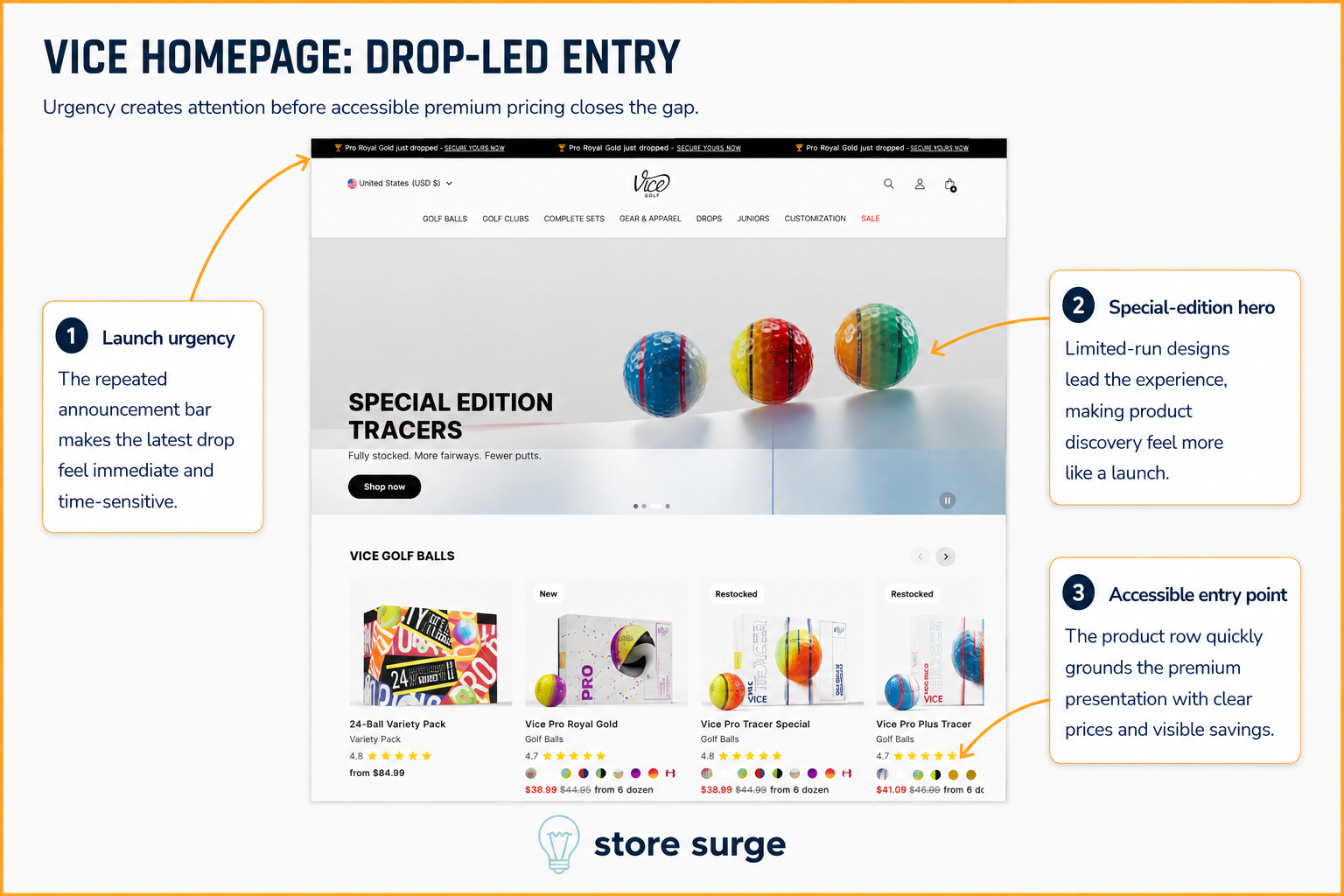
Before a visitor sees a single product, Vice puts a repeated announcement bar across the very top of the page: "Pro Royal Gold just dropped, secure yours now." Repeating the same message three times across the bar makes the latest release feel immediate rather than something a shopper might casually get around to.
The hero carousel underneath continues the same energy. Special Edition Tracers get full-bleed product photography and copy that reads like a launch announcement, not a routine merchandising slot. Limited-run designs leading the homepage make ordinary product discovery feel like arriving at an event already in progress.
Immediately below that, a straightforward product row grounds the excitement with real prices and visible savings on the 24-Ball Variety Pack, Vice Pro Royal Gold and other core SKUs. The drop creates attention, and the row directly underneath converts it, without ever making the entry-level product feel like an afterthought.
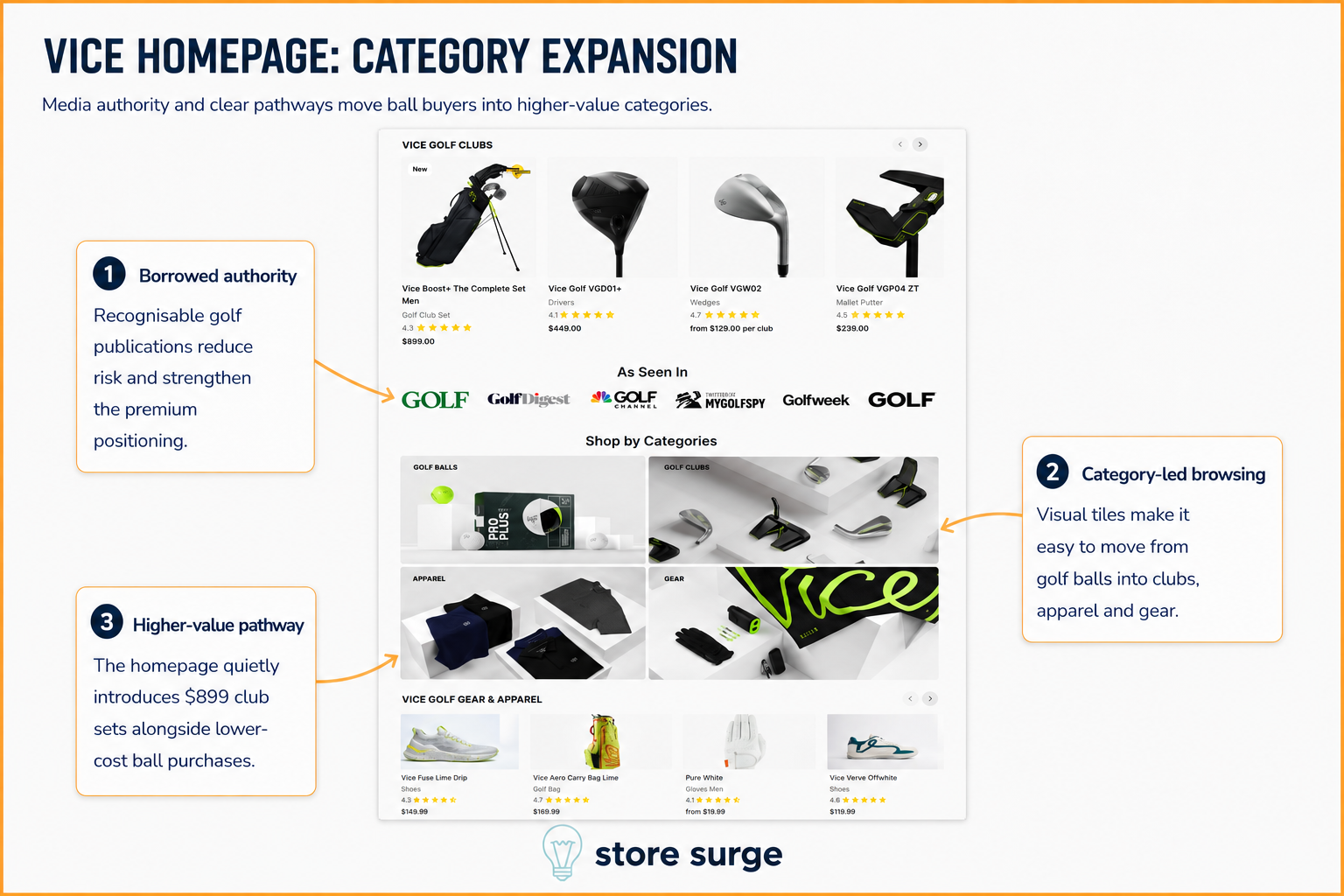
Scroll a little further and the homepage quietly starts introducing categories most visitors didn't come for. A Vice Golf Clubs carousel sits directly beneath the balls carousel, featuring an $899 complete set alongside a $449 driver, right next to gear priced at $19.99 and up.
Directly under that carousel, a row of recognisable golf publication logos, GOLF, Golf Digest, Golf Channel, MyGolfSpy, Golfweek, does some quiet work. Media authority reduces the risk of a comparatively lower-priced brand also asking shoppers to trust it with a $900 purchase.
A "Shop by Categories" tile grid follows: Golf Balls, Golf Clubs, Apparel, Gear, each with clean lifestyle photography. Visual tiles make moving between categories feel like browsing rather than searching, which matters when the goal is getting a ball buyer to at least look at a driver.
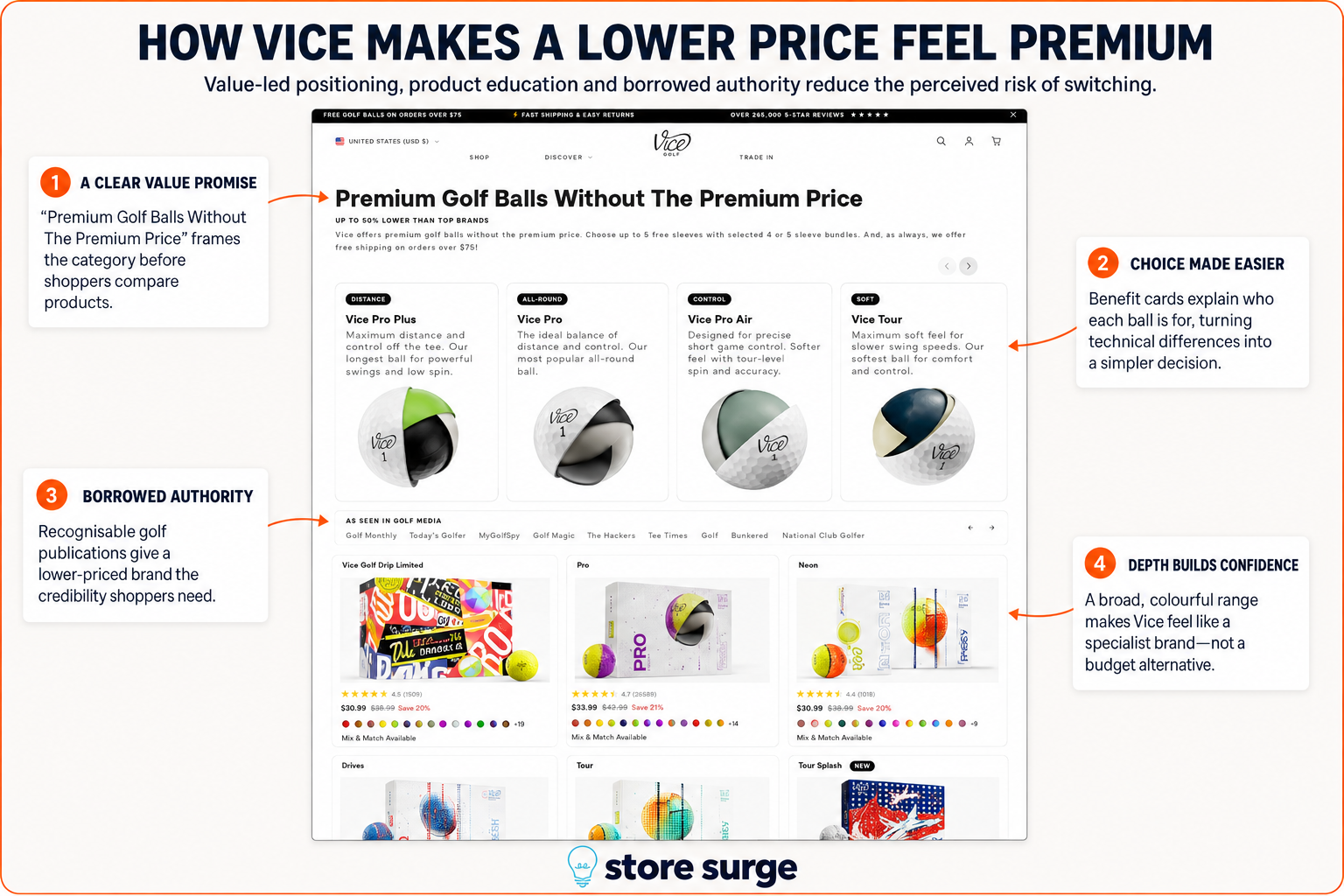
The Golf Balls category page opens with the line that sums up Vice's whole positioning: "Premium Golf Balls Without The Premium Price," backed by a claim of up to 50% lower pricing than top brands. Framing the category before a shopper starts comparing individual products means the comparison happens on Vice's terms.
A top bar stacks proof before anyone scrolls: free balls on orders over $75, fast shipping, and over 265,000 five-star reviews. Four benefit cards, Vice Pro Plus, Vice Pro, Vice Pro Air, Vice Tour, translate technical differences like spin and swing speed into a simple which-one-is-for-me decision.
Underneath, an "As Seen In Golf Media" strip repeats the borrowed-authority tactic from the homepage, and a genuinely broad, colourful product range with mix-and-match availability makes Vice read as a specialist brand rather than a budget alternative. Depth is doing a lot of the confidence-building here.
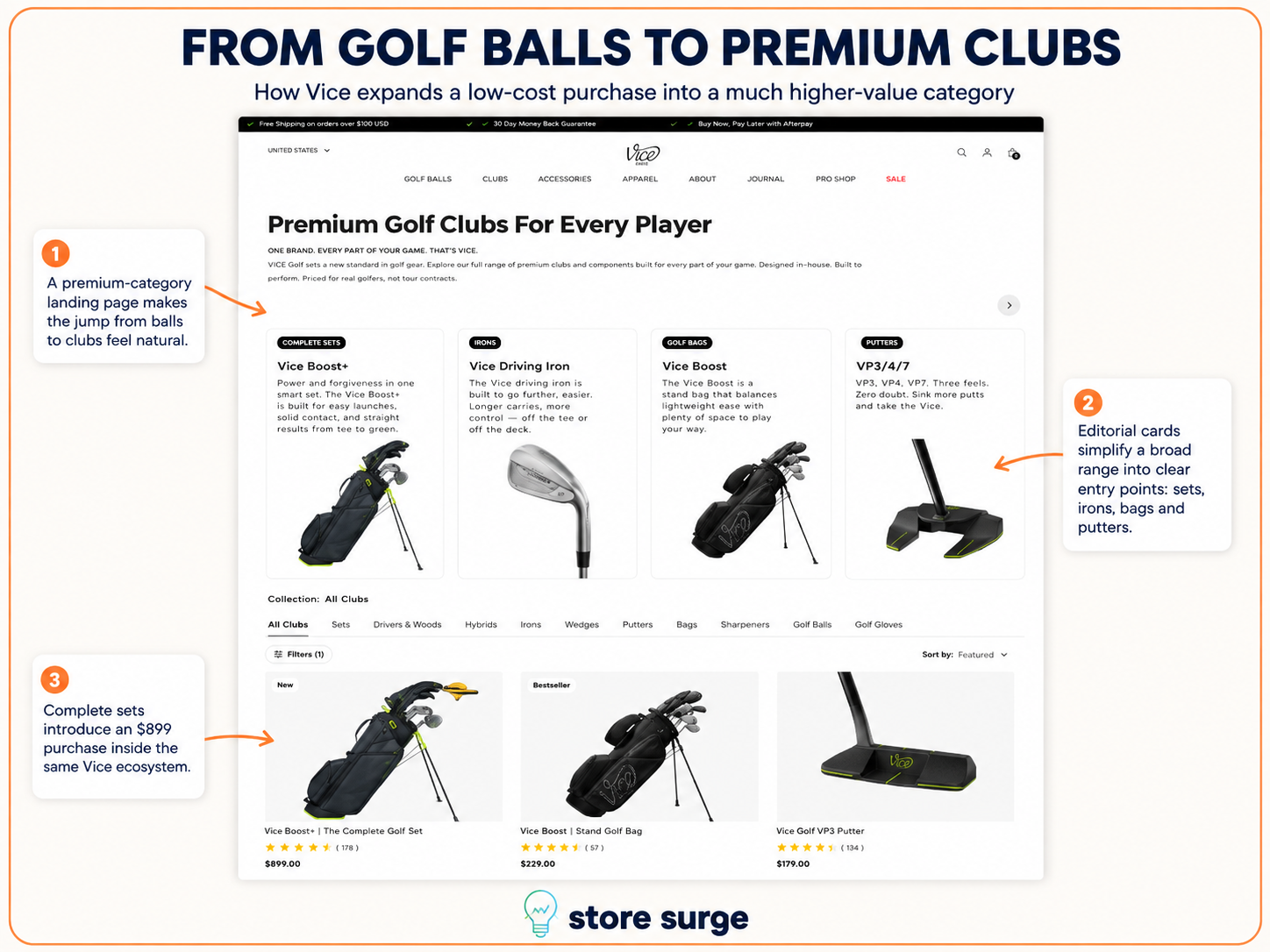
The dedicated clubs landing page is where the jump from a $35 sleeve of balls to a $900 set gets made to feel natural. The header reads "One brand. Every part of your game. That's Vice," positioning clubs as a continuation of the same relationship rather than a separate, harder sell.
Four editorial cards, Complete Sets, Irons, Golf Bags, Putters, simplify what could be an intimidatingly broad catalogue into four clear entry points. Each one leads with a short, benefit-led line rather than a spec sheet.
Scroll into the grid and the Vice Boost+ Complete Set ($899), the Vice Boost Stand Bag ($229) and the VP3 Putter ($179) sit in the exact same star-rating, review-count visual language shoppers already trust from the balls range. The price jump is real, but the format around it isn't asking for any new trust.
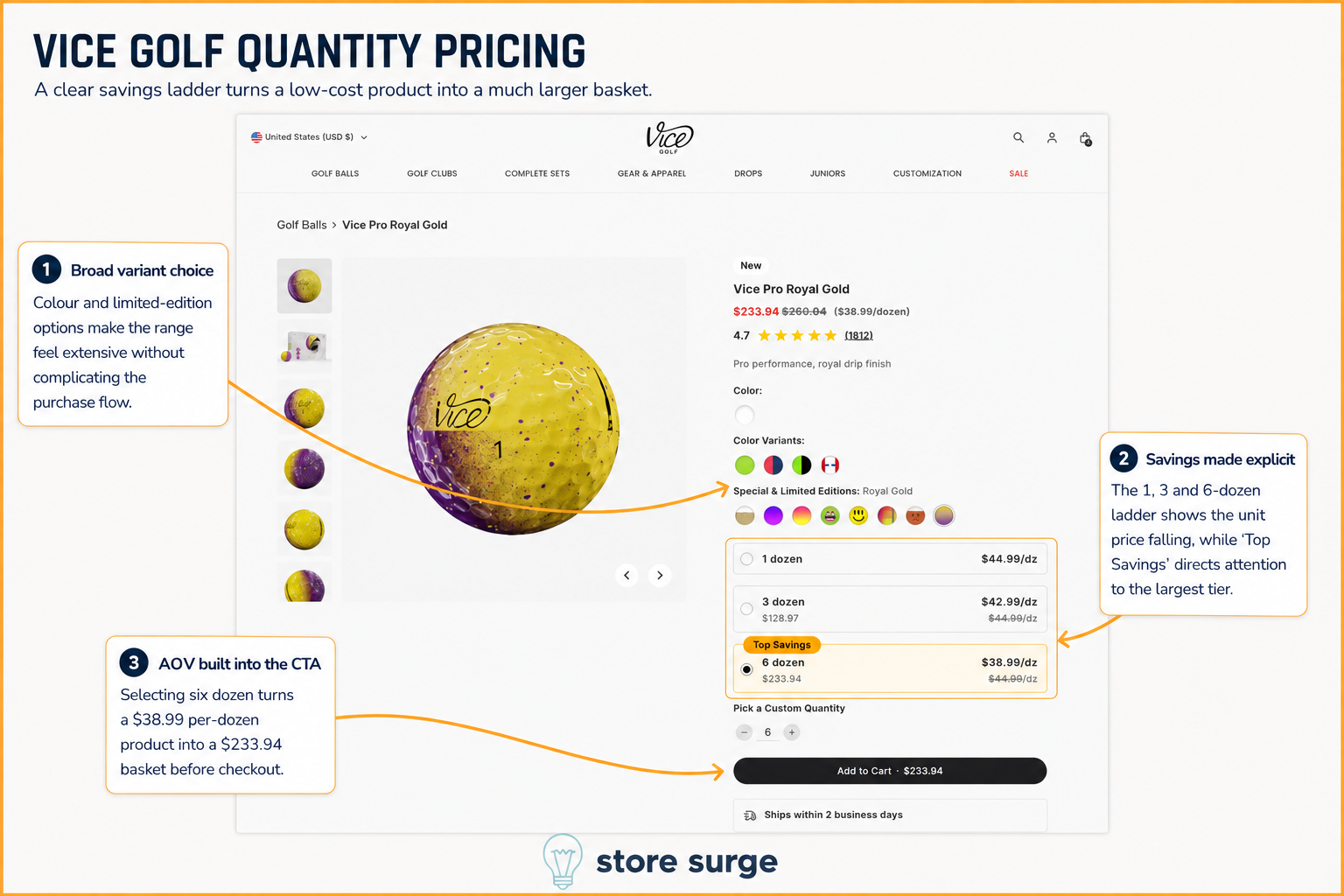
Back on a single product, the Vice Pro Royal Gold page uses a different AOV lever entirely than a bundle or a frequently-bought-together module. A 1, 3 and 6-dozen pricing ladder shows the unit price falling as quantity rises, from $44.99 to $42.99 to $38.99 per dozen, with a "Top Savings" badge pointing straight at the largest tier.
Selecting six dozen turns a $38.99-per-dozen product into a $233.94 basket, and that happens inside the default purchase flow rather than as a separate upsell step after Add to Cart. The saving is the incentive; the higher spend is just what claiming it requires.
A broad colour and limited-edition variant grid sits above the pricing table, making the range feel extensive without ever complicating the actual decision: there's still only one primary Add to Cart action on the page.
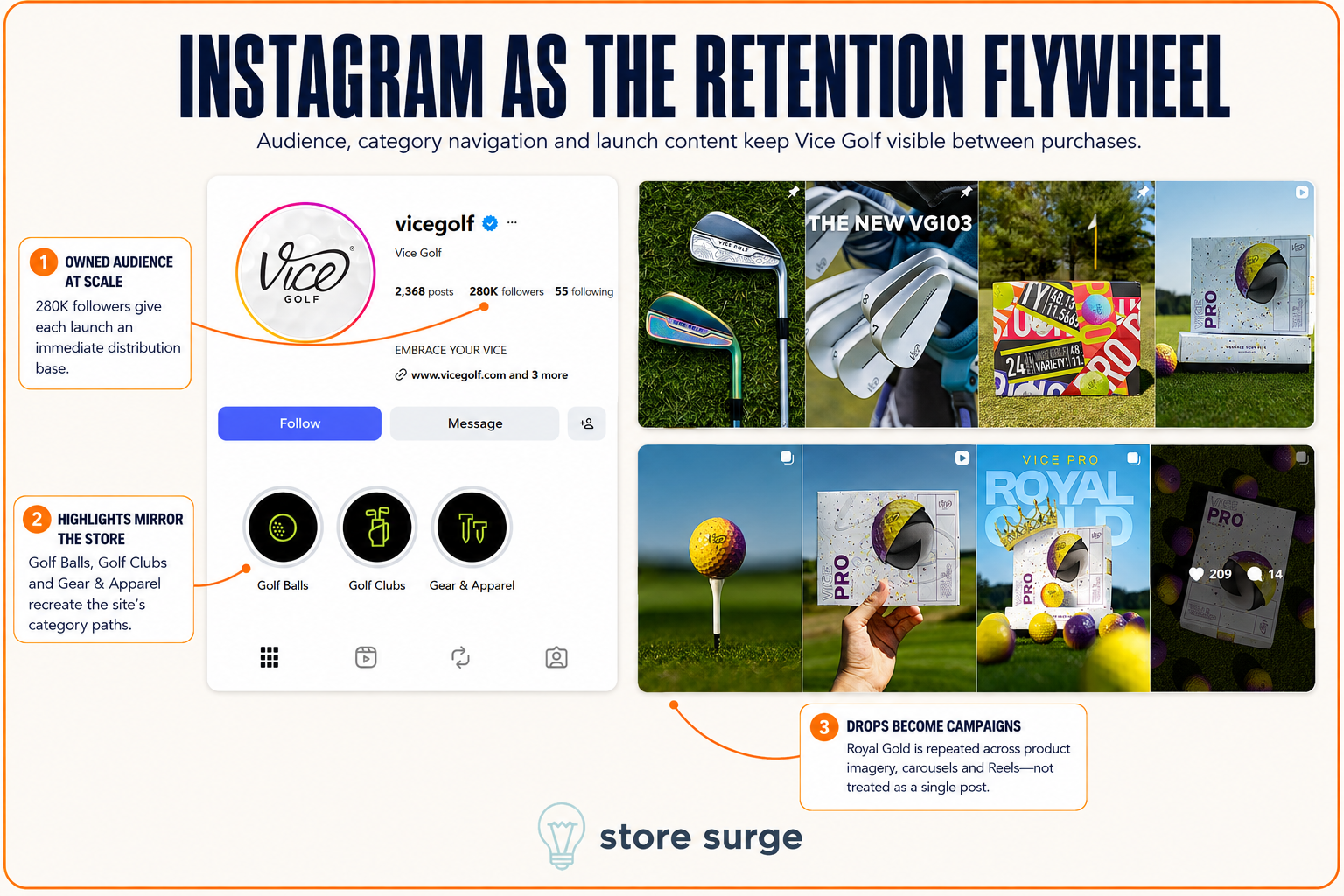
Vice's Instagram profile, @vicegolf, carries 280,000 followers and a verified badge, and its story highlights, Golf Balls, Golf Clubs, Gear & Apparel, mirror the site's own top-level navigation almost exactly. Anyone landing on the profile gets the same shopping structure as the website, just one tap away from a purchase.
The Royal Gold drop isn't treated as a single post. It shows up as close-up product photography, a Reel built around a crown graphic, lifestyle shots of the ball on a tee, and unboxing-style hand shots, with visible engagement (209 likes, 14 comments on one grid post) reinforcing that other people are already excited about it.
None of this replaces paid acquisition, but 280,000 owned followers mean every future drop gets a running start before a single pound of Meta ad spend is committed. It's a big part of why the urgency banner at the very top of the homepage can do as much work as it does.
Vice Golf's site isn't just selling golf balls cheaply. It's using an aggressively priced, high-trust entry product to fund credibility for a much higher-ticket category, then quietly building every homepage module, category page and Instagram highlight around getting a ball buyer to eventually look at a $900 set.
That's a different kind of system to a straightforward CRO teardown. It's closer to a value ladder: win trust cheap, then spend that trust on bigger baskets, one quantity tier and one category tile at a time.
If you're building out a multi-category catalogue and want help designing that kind of ladder, get in touch. We help ecommerce brands connect CRO, paid media and email into one system that moves customers up the value chain, not just through a single checkout.
