

In this article, we explore how modern ecommerce brands are building scalable content systems rather than relying on isolated marketing campaigns. We cover:
Many ecommerce brands still approach content in a fragmented way. One week they post a TikTok video, the next week they launch a Meta ad, and then nothing happens for several days afterwards. This inconsistent approach is one reason many brands struggle to scale sustainably through modern digital marketing.
Today, successful content strategy for ecommerce brands is no longer simply about posting more frequently. The strongest brands now build structured ecommerce content systems designed to continuously generate:
As customer acquisition costs continue to rise across Meta, Google and TikTok, ecommerce brands increasingly need scalable systems that combine e-commerce video, paid advertising and retention marketing into a more unified long-term growth strategy.
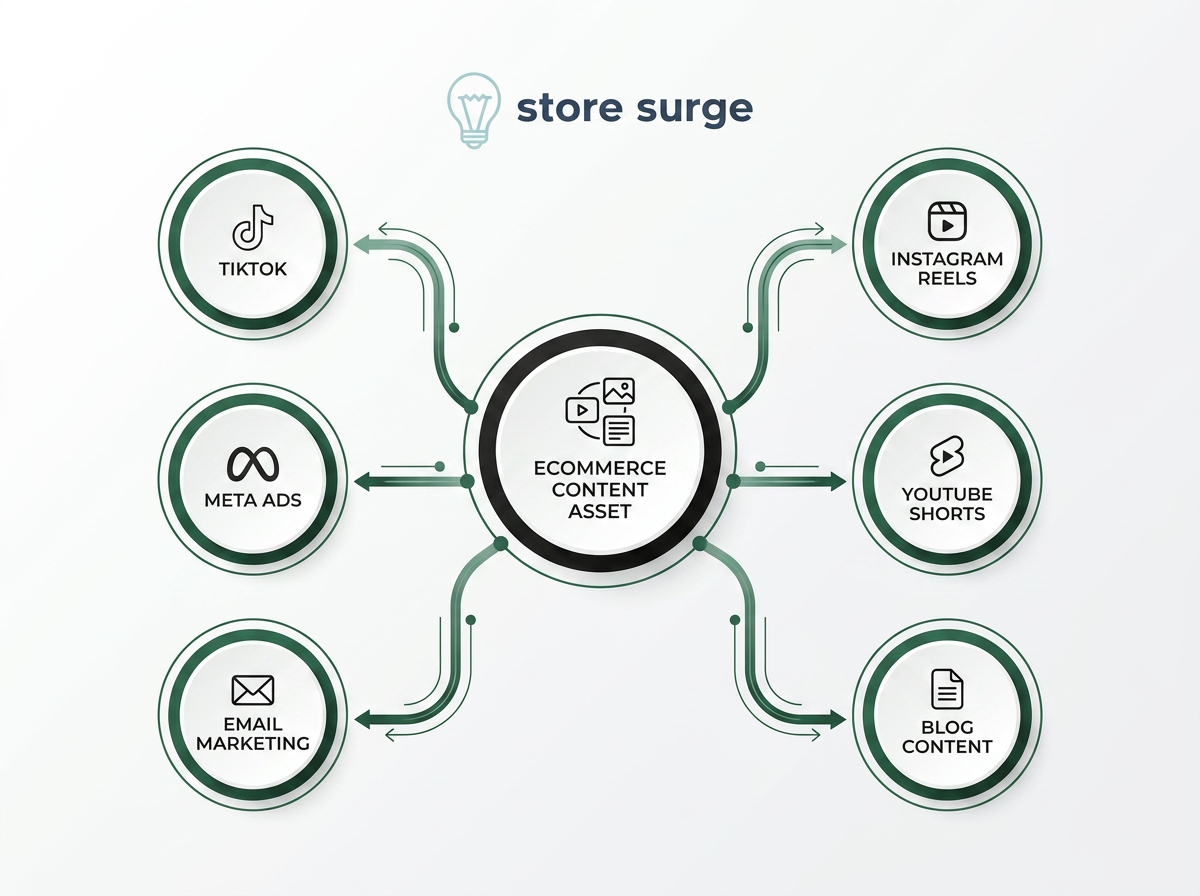
An ecommerce content system is a repeatable framework used to consistently produce, distribute and optimise marketing content across an ecommerce business.
Rather than creating isolated campaigns, modern brands now build systems that allow content to flow across:
from a single piece of creative production.
For example, one e-commerce video can often be repurposed into multiple forms of content, including paid ads, social posts, email campaigns and product page assets.
This is one reason video content has become increasingly important within modern content strategy for ecommerce brands. Rather than producing separate creatives for every platform, successful brands now focus on scalable content systems that maximise distribution, testing opportunities and long-term content efficiency.
Modern ecommerce advertising platforms reward creative velocity far more than many brands realise.
Creative fatigue happens quickly across Meta and TikTok. Audiences stop responding to the same hooks, formats and offers after repeated exposure. Brands that fail to consistently produce fresh content often experience:
As a result, the strongest ecommerce content systems now focus heavily on rapid testing, scalable production and content repurposing rather than producing a handful of overly polished campaigns each month.
This shift has significantly changed how content strategy for ecommerce brands is approached. Many successful ecommerce businesses now operate more like media companies, continuously producing e-commerce video and short-form content designed for testing, distribution and paid advertising performance.
Short-form video has become one of the most powerful forms of ecommerce marketing because it allows brands to combine entertainment, product education and social proof inside highly consumable content formats.
Platforms like TikTok, Instagram Reels and YouTube Shorts have dramatically changed consumer attention patterns. Customers increasingly expect fast-paced, visually engaging content that feels native to social media platforms rather than traditional advertising.
Strong e-commerce video content often includes:
rather than heavily scripted commercials.
This type of content performs particularly well inside ecommerce advertising environments because it blends naturally into social feeds while also generating valuable engagement and testing data for future campaigns.
As a result, many successful content strategy for ecommerce brands now place short-form video production at the centre of their wider marketing systems.
AI tools are rapidly changing how ecommerce brands produce and distribute content.
Many businesses now use AI-assisted workflows to:
at significantly greater speed than traditional marketing workflows.
However, AI alone is rarely enough to create strong ecommerce content systems. The brands seeing the best results typically combine human creative direction, customer psychology and strategic positioning alongside AI-assisted production rather than relying entirely on automated content generation.
This distinction is becoming increasingly important as low-quality AI-generated content continues to flood social media platforms and search engines.
For many modern brands, the goal is no longer simply producing more content, but building scalable content strategy for ecommerce systems that improve production speed, creative testing and long-term marketing efficiency.
Creating content alone is no longer enough.
Many ecommerce brands produce strong creative assets but fail to distribute them effectively across multiple channels. Successful ecommerce content systems therefore focus heavily on:
rather than isolated posting.
For example, a single piece of e-commerce video content can often be repurposed across TikTok, Instagram Reels, Meta Ads, YouTube Shorts, email campaigns and landing pages simultaneously.
This dramatically increases the return generated from each piece of creative production while also improving content efficiency, advertising performance and long-term brand visibility.
As a result, many modern content strategy for ecommerce brands now prioritise scalable distribution systems just as heavily as content creation itself.
Modern ecommerce growth increasingly depends on the ability to build scalable content systems rather than isolated marketing campaigns.
The brands most likely to succeed over the next few years will be those that successfully combine:
into structured, repeatable growth systems.
As customer acquisition becomes more competitive, many ecommerce brands will need stronger content strategy for ecommerce frameworks that prioritise creative production, distribution and long-term retention rather than short-term campaigns alone.
At Store Surge, the focus is not simply on producing more content, but on helping ecommerce brands build scalable content systems designed for sustainable long-term growth.
