
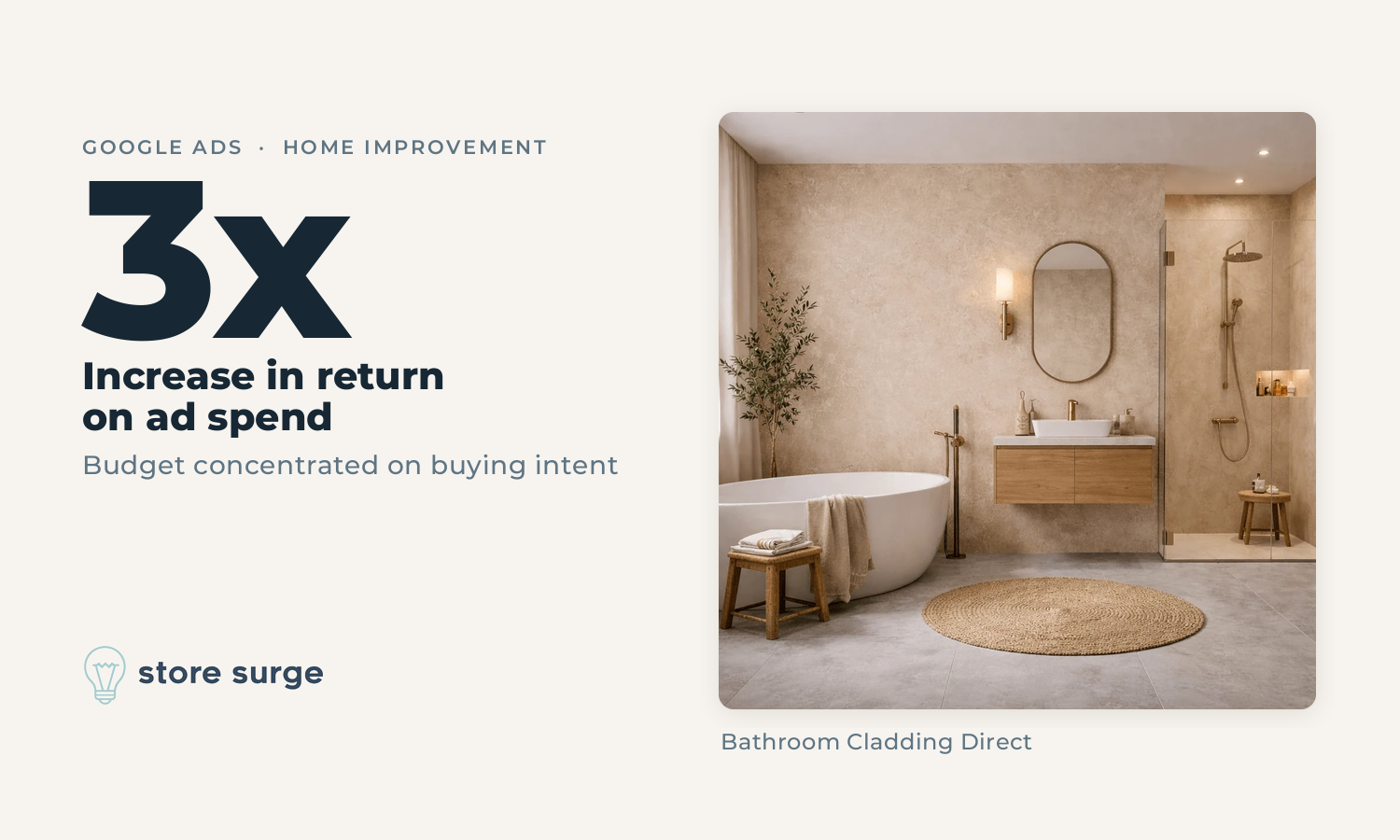
Bathroom Cladding Direct tripled its return on Google Ads spend by concentrating budget on the searches closest to a purchase decision.
Client: Bathroom Cladding Direct
Sector: Home improvement
Services: Google Ads
Bathroom Cladding Direct sells practical alternatives to traditional bathroom tiles, including waterproof wall panels and cladding.
The nature of the product creates a strong opportunity for Google Ads. Customers frequently search for these products when they are actively planning a renovation and are already comparing materials, styles and suppliers.
Our job was to ensure Bathroom Cladding Direct appeared for the right searches, and that its advertising budget was concentrated on the traffic most likely to generate revenue.
Google Ads performance is not simply about attracting the greatest possible number of visitors. The quality and intent of that traffic matter far more.
Someone searching broadly for bathroom inspiration may still be months away from purchasing. Someone looking for a particular type of bathroom cladding, panel or finish is likely to be much closer to placing an order.
Our approach focused on capturing this valuable demand while maintaining tight control over advertising costs. In practice that meant aligning campaigns with the products and searches demonstrating the strongest commercial intent, rather than paying for large volumes of loosely relevant traffic. It is the same structural discipline we apply to every Google Ads account.
Traffic volume was never the measure of success here.
By using accurate conversion tracking and assessing performance according to the value of the orders generated, we could make optimisation decisions based on revenue rather than surface-level engagement metrics.
That distinction matters more than it sounds. An account optimised towards clicks will reliably find you cheaper clicks. An account optimised towards order value will find you more valuable customers, and those are rarely the same searches.
Return on ad spend tripled over the period.
The practical effect of that is not simply a better number in a reporting dashboard. It changes what the account can do. At three times the efficiency, budget that previously bought a certain volume of revenue now buys considerably more, which means the account can absorb additional investment while still clearing the margin the business needs.
For Bathroom Cladding Direct, Google Ads became more than a source of website traffic. It became an efficient route to customers actively searching for the products the company supplied, at a level of efficiency that made increasing investment a straightforward decision rather than a risk.
Most accounts that underperform aren't broken. They're spread across too many searches, optimised towards the wrong signal, or measuring something other than revenue.
If your Google Ads account is producing sales but you suspect the budget could be working considerably harder, that's usually diagnosable fairly quickly. Happy to take a look.
